
Jay Johnson
Extending The Aerobic Stimulus: Get 12-Mile Benefits From 10-Mile Runs
Video timestamps
Transcript
Recorded speech. Speaker names describe the source; individual speaking turns may vary.
00:00.16–00:01.63 this video is for High School running
00:01.64–00:03.51 coaches coaches you know you need to
00:03.52–00:05.75 keep your kids injury free all year long
00:05.76–00:07.79 if you want them to PR this applies both
00:07.80–00:09.87 in cross country and in track we know we
00:09.88–00:11.91 have to build the aerobic engine as we
00:11.92–00:14.11 talk about in consistency is key we talk
00:14.12–00:15.95 about building the aerobic engine
00:15.96–00:17.71 strengthening the chassis revving the
00:17.72–00:20.55 engine that's the car analogy and
00:20.56–00:22.39 there's that that table in there that
00:22.40–00:26.63 says hey even the 800 is 60% aerobic
00:26.64–00:28.59 with the Anor robic contribution being
00:28.60–00:32.63 about 35% 35 to 40% but if you if we as
00:32.64–00:35.79 we go up to you know 1,600 is 82% then
00:35.80–00:39.95 3K or excuse me uh 3,200 is about 90 92
00:39.96–00:43.03 and the f5k is 95% so we need know we
00:43.04–00:45.23 need to build the aerobic engine but the
00:45.24–00:47.51 problem is too many coaches don't have a
00:47.52–00:50.27 safe progression of workouts that's
00:50.28–00:52.47 going to keep kids injuryf free so
00:52.48–00:54.31 oftentimes you know we're not going to
00:54.32–00:56.39 see shins plants necessarily in week one
00:56.40–00:58.59 or two or three but we do see it in week
00:58.60–01:01.31 four or five same with IT band injuries
01:01.32–01:03.31 same with calf injuries so what I'm
01:03.32–01:05.55 about to teach you is an approach that's
01:05.56–01:08.03 going to build the Aerobic System but
01:08.04–01:11.27 it's going to uh keep volume in a very
01:11.28–01:13.51 Progressive way that's going to keep
01:13.52–01:15.55 kids injury free all right so here's
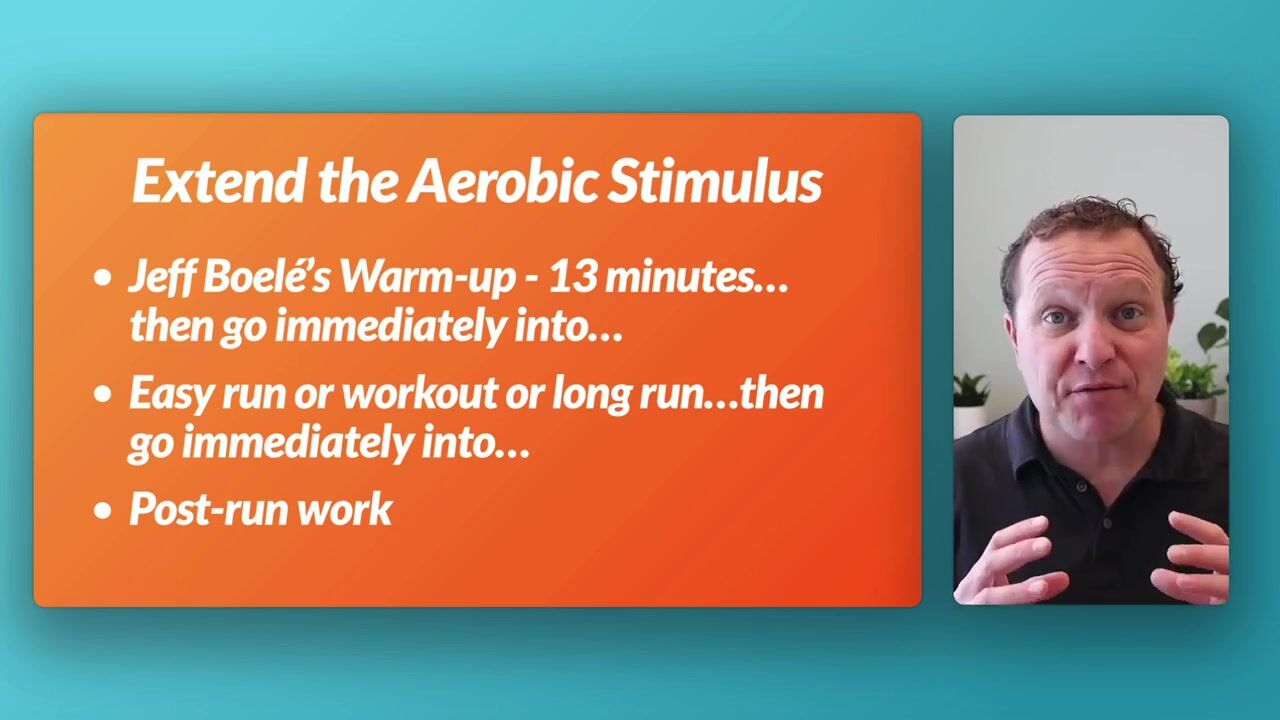
01:15.56–01:17.35 what we have we have Jeff B's warmup at
01:17.36–01:18.67 the end of this video I'll show you
01:18.68–01:19.99 where you can find that for free on
01:20.00–01:22.31 YouTube I'll show you how you can get it
01:22.32–01:25.19 uh on your phone on an app for free then
01:25.20–01:26.79 then we'll we'll talk about the run and
01:26.80–01:28.59 we'll talk about post run work Jeff's
01:28.60–01:30.67 warm-up takes 13 minutes once you learn
01:30.68–01:32.15 it the first time you teach it to your
01:32.16–01:33.83 kids we're looking at about 20 minutes
01:33.84–01:35.95 so you know the the first week of the
01:35.96–01:38.35 year uh that that's how long it it's
01:38.36–01:40.03 going to take the kids and in this first
01:40.04–01:42.51 slide we're assuming a fit athlete so
01:42.52–01:44.15 they're going to do a 60-minute long run
01:44.16–01:46.31 the first week back from school let's
01:46.32–01:48.59 say we're we're talking in the the track
01:48.60–01:51.35 season okay and if we go back to cross
01:51.36–01:52.99 country these were kids that were doing
01:53.00–01:55.63 70 maybe even 75 minute long runs but
01:55.64–01:57.23 probably more like a 70-minute long run
01:57.24–01:59.47 in September maybe you snuck in one more
01:59.48–02:02.07 long run in in October so we're actually
02:02.08–02:03.79 going to decrease the volume of their
02:03.80–02:06.19 long run in my approach to training
02:06.20–02:07.99 because the warmup takes time and the
02:08.00–02:10.11 postr Run Works takes time and as you're
02:10.12–02:11.91 about to see the overall time that
02:11.92–02:13.43 they're spending on their feet is a lot
02:13.44–02:15.67 of time by the time we get to week five
02:15.68–02:17.75 we'll be back up to a 70-minute long run
02:17.76–02:19.63 they'll be doing a ton of post-run work
02:19.64–02:21.83 and they're going to be working a lot
02:21.84–02:23.63 harder and a lot longer than than they
02:23.64–02:26.71 were in in your current training so uh
02:26.72–02:29.55 13-minute warm-up we go immediately into
02:29.56–02:31.79 this 60-minute long run and then
02:31.80–02:34.15 immediately after that we have Post Run
02:34.16–02:37.63 work now there's red hard uh is what we
02:37.64–02:40.19 would do on this day so what is Red
02:40.20–02:42.75 Heart well the post run work it goes red
02:42.76–02:45.67 is the easiest then yellow is or excuse
02:45.68–02:48.11 me then orange is the next uh more
02:48.12–02:49.99 challenging one more
02:50.00–02:52.63 challenging it goes red is the easiest
02:52.64–02:54.43 the next one in terms of how challenging
02:54.44–02:57.19 it is is orange then yellow then green
02:57.20–02:58.67 okay and I'm going to show you how you
02:58.68–03:00.95 can get red and orange orange for free
03:00.96–03:03.51 on your phone on your computer uh we
03:03.52–03:05.35 break them into hard days and easy days
03:05.36–03:06.91 well we we're doing a long run so we
03:06.92–03:09.43 need to do red hard on the easy days
03:09.44–03:11.83 kids would do red easy okay so it's just
03:11.84–03:13.71 very simple I like to keep things very
03:13.72–03:16.23 simple um as an aside sometimes people
03:16.24–03:17.91 look at my training and I'm going to
03:17.92–03:19.71 show you what some of these days look
03:19.72–03:22.23 like in terms of what the training looks
03:22.24–03:24.59 like on a document and it looks like
03:24.60–03:27.71 it's complex it's not complex it's just
03:27.72–03:31.15 we I'm recording this in 2024 and we're
03:31.16–03:35.07 going into the 2025 track season it for
03:35.08–03:37.99 the next one year 5 years 10 years
03:38.00–03:40.11 training is going to get more and more
03:40.12–03:42.51 sophisticated and what it takes to have
03:42.52–03:45.55 an athlete run well at your state level
03:45.56–03:46.83 whether you're in a small school
03:46.84–03:48.95 classification or a big school is a lot
03:48.96–03:52.03 more sophistication than when you know
03:52.04–03:54.19 when I ran in high school in the 1990s
03:54.20–03:56.39 okay so we just have to be honest that
03:56.40–03:57.83 hey we're going to have to do Post Run
03:57.84–04:00.27 work break it into hard days easy days
04:00.28–04:01.91 um we're not going to talk about strides
04:01.92–04:03.15 we're not going to talk about speed
04:03.16–04:04.39 development here but there's those
04:04.40–04:06.71 things too got off on a little bit of a
04:06.72–04:08.51 tangent so what's a total time 13
04:08.52–04:11.47 minutes 16 minutes only 5 minutes of
04:11.48–04:14.07 this 17-minute red hard is really
04:14.08–04:15.75 challenging and the reason that's
04:15.76–04:17.27 important to focus on the challenging
04:17.28–04:18.99 part is that's when the heart rate is
04:19.00–04:21.71 elevated but what we could see is that
04:21.72–04:23.75 hey if you add all this up you get 78
04:23.76–04:26.35 minutes they only did a 60-minute run
04:26.36–04:29.07 and they might have gotten a 78 minute
04:29.08–04:31.75 aerobic stimulus so we kept heart rate
04:31.76–04:33.67 high and we really built the aerobic
04:33.68–04:36.99 engine now I I'll be honest for a fit
04:37.00–04:39.99 athlete this 13-minute warmup might be
04:40.00–04:41.83 more like zero minutes you actually do
04:41.84–04:44.35 get the heart rate elevated with some uh
04:44.36–04:46.79 skipping and some Dynamic warmup but
04:46.80–04:48.99 then you go to the ground and do some
04:49.00–04:50.79 stuff on the ground and then you do some
04:50.80–04:53.11 Sprint mechanics and your heart rate
04:53.12–04:56.15 maybe isn't as high okay uh we're going
04:56.16–04:57.55 to talk in a moment about an athlete
04:57.56–04:59.87 who's L less fit and this 13 minutes is
04:59.88–05:01.79 going to be challenging for them so
05:01.80–05:03.67 let's say that you know they got zero
05:03.68–05:05.27 minutes in the warm-up and they only got
05:05.28–05:07.31 5 minutes in the post R work that's
05:07.32–05:10.27 still 65 minutes so in week one we got a
05:10.28–05:12.31 little bit more 5 minutes more of an
05:12.32–05:14.47 aerobic stimulus and we only you know
05:14.48–05:16.31 had the uh pounding on the pavement for
05:16.32–05:18.99 60 minutes okay now let's look at the
05:19.00–05:20.67 extending the aerobic stimulus for the
05:20.68–05:22.47 less fit athletes so this is going to be
05:22.48–05:24.07 an athlete who can only handle a
05:24.08–05:26.07 40-minute long run right this might have
05:26.08–05:27.99 been an athlete who in cross country you
05:28.00–05:29.71 know the longest long run they did was
05:29.72–05:31.71 45 or 50 minutes we're going to lower it
05:31.72–05:34.67 to 40 minutes the reason these are Aster
05:34.68–05:37.35 here 13 minutes with an asterisk and 17
05:37.36–05:39.59 minutes with two asterisk for this
05:39.60–05:42.87 athlete this entire warmup their heart
05:42.88–05:45.23 rate is going to be elevated so they so
05:45.24–05:47.03 we have 13 minutes of an elevated heart
05:47.04–05:48.87 rate then we have the 40-minute long run
05:48.88–05:51.59 red hard I think the first 12 minutes
05:51.60–05:53.15 will really be challenging for this
05:53.16–05:55.39 athlete also the math looks nice because
05:55.40–05:57.43 when we add all this up we've got 13 +
05:57.44–06:00.59 40 + 12 we've got a 65 minute aerobic
06:00.60–06:02.63 stimulus for this athlete because the
06:02.64–06:03.87 warm- Up's a little harder and the
06:03.88–06:05.55 post-run work is a little harder for
06:05.56–06:08.87 this athlete okay so I'm saying this
06:08.88–06:11.39 athlete could maybe have run 830 Pace if
06:11.40–06:14.63 they just went for a run and 830 Pace if
06:14.64–06:16.63 all they did in the in their normal
06:16.64–06:18.67 approach to training was a 40-minute run
06:18.68–06:22.99 that'd be a 4.7 mile run but 65 minutes
06:23.00–06:25.63 had they run 830 Pace had they run 65
06:25.64–06:27.55 minutes at 830 Pace that's equivalent to
06:27.56–06:30.91 a 7.6 mile run and we don't need to get
06:30.92–06:32.91 you know super specific about numbers
06:32.92–06:35.47 but I just want you to see this idea
06:35.48–06:37.95 that oh my gosh I can keep an athlete
06:37.96–06:40.23 injuryf free because they can definitely
06:40.24–06:43.51 handle 40 minutes but the aerobic engine
06:43.52–06:45.39 just like we talk about in consistency
06:45.40–06:47.63 key we're really building the aerobic
06:47.64–06:50.03 engine for this athlete setting them up
06:50.04–06:52.43 to have a great track season and and and
06:52.44–06:54.39 just so you know all this applies in the
06:54.40–06:56.19 summer leading up to cross country we're
06:56.20–06:58.03 we're doing some of the same workouts
06:58.04–06:59.63 okay so now let's go back to our fit
06:59.64–07:01.79 athlete what are we doing in week two uh
07:01.80–07:03.31 we're going to assume zero minutes for
07:03.32–07:05.63 the warm-up you know 13 minutes but
07:05.64–07:07.03 we're we're assuming they fit so they
07:07.04–07:09.59 don't get anything there um just a
07:09.60–07:11.35 little we'll dive into the progression
07:11.36–07:14.19 run a little bit um you you can learn
07:14.20–07:16.91 more about these key workouts uh on my
07:16.92–07:18.71 website I've got workouts where I talk
07:18.72–07:20.11 about these in both track and cross
07:20.12–07:22.27 country but quickly a progression run
07:22.28–07:23.67 we're going to do 7 Minutes of easy
07:23.68–07:26.39 running transition into 8 minutes and
07:26.40–07:27.63 within those eight minutes we're going
07:27.64–07:30.59 to do three strides at 20 seconds okay
07:30.60–07:32.75 so for 15 minute we you know we don't go
07:32.76–07:35.23 straight from just jogging straight into
07:35.24–07:37.15 this uh progression run what is the
07:37.16–07:39.87 progression Run 10 minutes steady then 5
07:39.88–07:41.39 minutes a little bit faster but
07:41.40–07:43.79 controlled 5 minutes a little bit faster
07:43.80–07:46.03 but controlled and then five ending with
07:46.04–07:48.35 5 minutes fast but controlled and what
07:48.36–07:49.83 kids need to be able to say this is
07:49.84–07:51.75 something in consistency is key they
07:51.76–07:53.83 need to be able to always say after runs
07:53.84–07:55.79 I either could have gone farther or I
07:55.80–07:58.99 could have gone faster for a long run we
07:59.00–08:00.51 want kids to be able to say I could have
08:00.52–08:03.03 gone farther and sped up in this
08:03.04–08:06.15 progression run I just need to you you
08:06.16–08:08.15 need your athlete to be able to say hey
08:08.16–08:10.47 coach I had seven or eight more minutes
08:10.48–08:12.87 at that last Pace you know I'm I'm glad
08:12.88–08:15.23 I was done I'm glad we only did 25
08:15.24–08:16.95 minutes but if that last 5 minute
08:16.96–08:18.23 segment would have been seven or eight
08:18.24–08:19.95 minutes I totally would have been fine
08:19.96–08:22.67 okay so we've done 7 Minutes 8 minutes
08:22.68–08:24.95 25 minute progression run and then let's
08:24.96–08:27.75 go 5 minutes easy all of this is
08:27.76–08:30.27 continuous running okay so we've chopped
08:30.28–08:32.39 it up into different segments here on
08:32.40–08:35.67 the screen but this is one 45 minute run
08:35.68–08:37.51 now we're going to do orange hard in
08:37.52–08:40.07 week two because your fit athlete can do
08:40.08–08:42.07 more more Post Run work even in the
08:42.08–08:44.03 second week so we got zero for the
08:44.04–08:46.47 warm-up 45 for the Run 15 for the postr
08:46.48–08:50.15 Run work because even here's the deal at
08:50.16–08:52.71 the end of the progression run even
08:52.72–08:54.31 though they ran five minutes easy they
08:54.32–08:56.39 do 25 minutes they get 5 minutes easy
08:56.40–08:58.67 their heart rate's going to be up and
08:58.68–09:01.19 they're going to be tired not crazy
09:01.20–09:02.91 tired because remember we ended at a
09:02.92–09:05.23 controlled Pace but they're tired so
09:05.24–09:08.23 orange hard is 22 minutes and the first
09:08.24–09:10.19 or they're doing this in week two they
09:10.20–09:11.83 will absolutely have their heart rate
09:11.84–09:14.67 elevated for 15 minutes so we get a
09:14.68–09:16.35 solid 15 minutes where their heart
09:16.36–09:18.15 rate's elevated and then I'll I'll show
09:18.16–09:19.75 you what some of these exercises are in
09:19.76–09:21.67 orange hard you'll see a lot of them are
09:21.68–09:23.63 hip mobility you
09:23.64–09:26.27 know strengthening exercises for your
09:26.28–09:27.99 back and whatnot so the last seven
09:28.00–09:29.67 minutes you you're they're on the ground
09:29.68–09:31.59 and it's not as hard bottom line is we
09:31.60–09:34.11 got our 60-minute stimulus here and what
09:34.12–09:36.51 I want you to say is hey let's say this
09:36.52–09:38.87 athlete between the warmup and the or
09:38.88–09:40.03 you know between the running at the
09:40.04–09:41.91 beginning of the workout that was slower
09:41.92–09:43.55 then some fast running for the
09:43.56–09:45.47 progression run and then the 5 minutes
09:45.48–09:47.43 easy let's just make the math easy and
09:47.44–09:51.55 say 7:30 pace for 45 mes or 7:30 6:30
09:51.56–09:52.95 pace for 45 minutes would have been
09:52.96–09:56.43 about 77 mil but had they done that for
09:56.44–09:58.91 60 minutes that's the equivalent of 9
09:58.92–10:02.59 miles so this is the magic of extending
10:02.60–10:05.91 the aerobic stimulus is that we're
10:05.92–10:08.59 getting we are not pounding the pavement
10:08.60–10:10.67 for 9 miles but we're getting the
10:10.68–10:12.51 fitness they would have gotten in 9
10:12.52–10:16.23 miles and and when your kids now as I'm
10:16.24–10:17.99 doing this and you
10:18.00–10:20.47 know what's going on in my mind thinking
10:20.48–10:21.79 of what you're thinking on the other
10:21.80–10:23.27 side is you're probably thinking yeah
10:23.28–10:24.43 but this is going to be really hard to
10:24.44–10:25.87 sell to my kids because they've got
10:25.88–10:27.99 their choros watch they're hooked up to
10:28.00–10:30.35 straa they're going to see kids you know
10:30.36–10:33.31 at other schools um running more miles
10:33.32–10:35.19 you got to get the kids bought into this
10:35.20–10:37.15 that hey in the first week the second
10:37.16–10:39.47 week the fifth week the eighth week of
10:39.48–10:41.43 the winter and the summer we can run
10:41.44–10:44.11 less volume but we're we're going to be
10:44.12–10:45.75 gaining as much Fitness as those other
10:45.76–10:48.87 teams and I'll sh I'll link to that well
10:48.88–10:50.43 I'm actually going to show you a QR code
10:50.44–10:52.59 at the end that'll take you to my track
10:52.60–10:54.07 training system and my CrossCountry
10:54.08–10:56.31 training system if if you're kind of on
10:56.32–10:57.79 the fence you're like I don't know if
10:57.80–10:58.95 this guy Jay really knows what he's
10:58.96–11:00.23 talking about I don't know if this is
11:00.24–11:01.99 really going to work read the
11:02.00–11:05.11 testimonials from coaches who kid whose
11:05.12–11:07.07 programs have done this all their kids
11:07.08–11:09.35 stay injury free and all their kids run
11:09.36–11:13.75 PRS so this will absolutely work okay so
11:13.76–11:15.07 and this is what I just said in teal
11:15.08–11:17.03 hair they're going to stay injury-free
11:17.04–11:20.11 and gain a ton of aerobic fitness you've
11:20.12–11:22.15 got to buy into this idea that we have
11:22.16–11:25.03 to build the aerobic engine but what we
11:25.04–11:27.79 have to do is is build it as big as
11:27.80–11:30.59 possible safely right so it's not an
11:30.60–11:33.31 either or it's a both and all right and
11:33.32–11:34.63 then let's look at the fit athlete in
11:34.64–11:37.87 week five again zero warm-up but you'll
11:37.88–11:39.59 have other kids on your team the newer
11:39.60–11:41.23 kids who will gain some Fitness in the
11:41.24–11:44.27 warm-up 70-minute long run um now
11:44.28–11:46.75 they're doing yellow hard and so we went
11:46.76–11:49.59 red orange yellow um I only share red
11:49.60–11:51.63 and orange with you for free yellows in
11:51.64–11:53.55 these training systems but just trust me
11:53.56–11:57.35 on this that 25 minutes here at least
11:57.36–11:59.35 the first 15 will be challenging if if
11:59.36–12:01.83 not more so we've got 85 minutes let's
12:01.84–12:05.03 assume 7 minute pace so you know a 70
12:05.04–12:06.99 minute run at 7 minute pace that's 10
12:07.00–12:10.47 miles but uh 85 minutes at 7 minute pace
12:10.48–12:12.87 is basically 12 miles so another example
12:12.88–12:15.79 of the aerobic stimulus was a 12 M run
12:15.80–12:17.43 even though the amount of pounding on
12:17.44–12:19.83 their body was only 10 mil the one thing
12:19.84–12:21.39 I want to say
12:21.40–12:24.51 here put yourself in the shoes of the
12:24.52–12:27.07 athlete for a moment when they finish a
12:27.08–12:28.75 70-minute run what do they want to do
12:28.76–12:29.91 they want to take take a break and have
12:29.92–12:31.07 some water and chitchat with their
12:31.08–12:34.43 friends it's a mental challenge to go
12:34.44–12:36.79 straight into 25 minutes of post run
12:36.80–12:39.59 work at the end of 70 minutes one of the
12:39.60–12:41.23 things I love talking about and
12:41.24–12:45.63 consistency is key excuse me is build
12:45.64–12:47.63 your attention span for hard work that's
12:47.64–12:49.95 the second chapter right it comes early
12:49.96–12:52.03 in the book because athletes if they
12:52.04–12:53.71 want to be great distance Runners have
12:53.72–12:55.39 to build their attention span for hard
12:55.40–12:57.43 work and we had this as a zero the
12:57.44–13:00.07 warm-up it's that's a 13 minute warmup
13:00.08–13:02.67 right this is 25 this is 70 so what is
13:02.68–13:06.03 that that's 38 + 70 so that's 108
13:06.04–13:08.55 minutes so that's an hour 45 technically
13:08.56–13:12.55 an hour 48 an hour 45 in week five your
13:12.56–13:15.67 athlete is moving continuously for 1
13:15.68–13:18.35 hour and 48 minutes and when they got to
13:18.36–13:21.23 the end of the Run they had to mentally
13:21.24–13:23.59 say I'm you know I'm ready to go for
13:23.60–13:25.47 almost like the the this the second
13:25.48–13:27.39 workout the second part of the workout
13:27.40–13:29.91 so this is a great way
13:29.92–13:32.11 and and and there's an article that I I
13:32.12–13:33.95 shared with people on my newsletter that
13:33.96–13:35.71 talked about this and and one of the
13:35.72–13:37.47 things I pointed out is we're doing this
13:37.48–13:39.03 in the winter or we're doing this in the
13:39.04–13:41.75 summer but when the race Pace workouts
13:41.76–13:44.67 start in the competitive season these
13:44.68–13:46.83 kids are mentally ready to handle that
13:46.84–13:48.83 because they handled this type of
13:48.84–13:51.87 workout okay let's see what the warm-up
13:51.88–13:54.07 looks like and the post run workk okay
13:54.08–13:55.31 so where you going to get the warmup
13:55.32–13:56.47 where you going to get the post on workk
13:56.48–13:58.43 you're going to scan this QR code here
13:58.44–14:01.07 it's going to take you to this page and
14:01.08–14:03.43 all this is all free put in your email
14:03.44–14:05.51 address sign up for free okay what is it
14:05.52–14:07.07 going to take you to it's going to take
14:07.08–14:09.43 you to this and we get the warmup and
14:09.44–14:11.27 then we're going to get the post R work
14:11.28–14:12.67 one of the things I want to show you is
14:12.68–14:14.19 you can always get this for free on
14:14.20–14:16.91 YouTube too uh close that but but this
14:16.92–14:18.51 is the warmup this is just the beginning
14:18.52–14:20.47 of it there's some lateral stuff we're
14:20.48–14:22.99 going to do some stuff like leg swings
14:23.00–14:25.55 um then there's some Sprint drills that
14:25.56–14:27.91 they're doing in here just a marches B
14:27.92–14:29.83 marches stuff like that
14:29.84–14:31.83 um but I do think the the best thing to
14:31.84–14:34.95 do is to get the the it's basically like
14:34.96–14:37.19 a free app on your phone and have it
14:37.20–14:40.51 there okay so when you log in there um
14:40.52–14:42.27 here we go training
14:42.28–14:45.63 videos warm-ups Post run and then these
14:45.64–14:49.15 are my old videos corx lunge Matrix Sam
14:49.16–14:50.99 just for you to have as in reference
14:51.00–14:52.31 obviously you can find all those for
14:52.32–14:53.95 free on YouTube but these now they're in
14:53.96–14:56.39 one place so you you click on warm-ups
14:56.40–14:58.39 then Jeff bule's warmup it's the exact
14:58.40–15:00.27 same warm-up we had in there I also
15:00.28–15:02.79 added uh lunge leg swings and lunge
15:02.80–15:05.75 Matrix now when you click this this is
15:05.76–15:08.87 the download that has the warmup and all
15:08.88–15:11.31 the post run work so I've listed out
15:11.32–15:12.99 everything in Jeff's warmup and as we
15:13.00–15:14.71 talked about I said the heart rate
15:14.72–15:16.59 really gets elevated when we start
15:16.60–15:18.87 that's all this stuff look skipping
15:18.88–15:21.07 backward walks butt kicks side shuffle
15:21.08–15:22.79 all that stuff but then we move to the
15:22.80–15:25.07 fence and do leg swings and I do think
15:25.08–15:26.39 if your athletes were wearing a heart
15:26.40–15:28.39 rate monitor we don't need to do this
15:28.40–15:31.03 but we're say um heart rate would stay
15:31.04–15:33.47 elevated in here heart rate does dip a
15:33.48–15:35.15 little bit when they move to the ground
15:35.16–15:37.55 for your fit athletes Sprint mechanics
15:37.56–15:38.99 it's kind of up and down because some
15:39.00–15:42.31 are marches some some are skits skips I
15:42.32–15:44.15 do think for I'm going to zoom that out
15:44.16–15:46.43 a little bit I do think for your younger
15:46.44–15:49.35 athletes this whole thing heart rate's
15:49.36–15:51.75 going to be up so that's why this whole
15:51.76–15:53.99 premise of extending the arobic stimulus
15:54.00–15:56.75 for a for a young athlete who's less fit
15:56.76–15:57.99 heart rate's going to be elevated
15:58.00–15:59.91 through this whole thing now so what is
15:59.92–16:02.99 post run work well this was the easy day
16:03.00–16:04.71 um Post Run work on the easy day is Big
16:04.72–16:07.43 Five again this is red this isn't super
16:07.44–16:09.23 challenging it's just push-ups and body
16:09.24–16:12.11 squats then we do a lot of uh Mobility
16:12.12–16:14.99 here when we get to the hard day it's
16:15.00–16:17.11 the lunge Matrix and if you've always
16:17.12–16:19.19 used that as a warm-up I think for your
16:19.20–16:21.59 young athletes who are really weak it's
16:21.60–16:24.87 actually a good strengthening um routine
16:24.88–16:26.75 that they can do so they do that and
16:26.76–16:28.11 then they go back and do everything
16:28.12–16:30.35 that's an easy fast forward to Orange
16:30.36–16:32.75 I've got all the warm-up stuff in here
16:32.76–16:35.47 um they do Jeff bullet they do lunge
16:35.48–16:38.19 Matrix Jeff Bulet multi-directional cool
16:38.20–16:40.87 down and some some stuff in here this is
16:40.88–16:43.11 all you know backwards jog backwards
16:43.12–16:45.31 skip single leg hop all these things so
16:45.32–16:47.47 heart rate stays elevated on the hard
16:47.48–16:50.07 days man in Orange it already gets hard
16:50.08–16:52.51 we're doing the lower body circuit white
16:52.52–16:54.67 outs mountain climbers wave lunges those
16:54.68–16:55.99 are all things that are really going to
16:56.00–16:57.75 challenge the lower body and then we do
16:57.76–17:00.79 corx we go through corx one time and
17:00.80–17:02.99 then we go through and do Jeff's um
17:03.00–17:05.15 multi-directional cool down and then all
17:05.16–17:07.51 this stuff in here as well so that's
17:07.52–17:10.75 what all that stuff looks like and um
17:10.76–17:12.95 now if you're wondering I'm I'm giving
17:12.96–17:15.11 you a little look right now inside the
17:15.12–17:18.67 uh track training system so Ju Just so
17:18.68–17:21.43 you can see um these are the videos in
17:21.44–17:23.99 here we we explained these workouts and
17:24.00–17:25.27 this is the meat of it that people
17:25.28–17:26.47 really want to see what do these
17:26.48–17:28.91 calendars look like right what is a a
17:28.92–17:30.67 calendar over the course of the year
17:30.68–17:32.91 colorcoded but when we get to the Daily
17:32.92–17:35.75 plans we could click on this and we
17:35.76–17:40.27 talked about doing a long run 60 right
17:40.28–17:42.47 who did a 70-minute long run let's say
17:42.48–17:43.87 in Cross Country we're going to start
17:43.88–17:46.43 them on the long run 60 plan in track
17:46.44–17:48.47 and what does that look like that looks
17:48.48–17:51.63 like this so this is what we had in here
17:51.64–17:54.95 we had our um our long run of 60 Minutes
17:54.96–17:57.11 of first week then in week two just like
17:57.12–17:58.83 we talked about we do a progression run
17:58.84–18:01.43 Run for the total time is 45 minutes we
18:01.44–18:03.59 did Red hard the first week and then
18:03.60–18:06.39 we're doing um orange hard the second
18:06.40–18:08.07 week what I want to show you is that
18:08.08–18:10.31 when we get to week five now we're doing
18:10.32–18:12.63 yellow hard and then when we get later
18:12.64–18:15.59 on in the year um not later in the year
18:15.60–18:17.39 later on in the season when we get to
18:17.40–18:18.79 week seven or eight or nine they should
18:18.80–18:21.31 advance to from yellow to green and
18:21.32–18:22.63 green is really
18:22.64–18:24.71 challenging I would say that that that
18:24.72–18:27.59 yellow is very challenging too so um
18:27.60–18:29.91 final thing is if you want to learn more
18:29.92–18:31.07 about the cross country and track
18:31.08–18:34.39 training system here's the QR codes um
18:34.40–18:36.99 what I would say is if you're a
18:37.00–18:41.15 coach excuse me if you're a coach and
18:41.16–18:42.83 you truly want to keep your kids injury
18:42.84–18:45.55 free and have them run PR week after
18:45.56–18:48.35 week after week you're going to to to
18:48.36–18:51.55 scan these just read the testimonials
18:51.56–18:54.19 from your peers you know read what what
18:54.20–18:56.59 coaches in in your shoes have have been
18:56.60–18:58.83 doing with these Training Systems okay
18:58.84–19:00.91 okay and if you ever have questions I'm
19:00.92–19:04.51 info@ coj johnson.com I'll I'll I'll put
19:04.52–19:06.19 that on the screen here and then I'll
19:06.20–19:10.03 link definitely to let's go back here
19:10.04–19:11.59 well no I should go back here and show
19:11.60–19:13.83 you this slide I'll I'll link to this in
19:13.84–19:17.03 here um you can scan the QR code but you
19:17.04–19:18.79 know absolutely get the free training
19:18.80–19:20.95 videos and PDFs and and your athletes
19:20.96–19:22.83 can get this too you guys can all have
19:22.84–19:26.15 it on your phone at the track okay this
19:26.16–19:28.55 is on YouTube one final thing and you
19:28.56–19:30.07 know know what I'm about to say if you
19:30.08–19:32.95 can like this video And subscribe to my
19:32.96–19:34.95 channel I'm just going to be putting
19:34.96–19:37.35 information for High School coaches and
19:37.36–19:39.51 then um I I will do some things for high
19:39.52–19:41.23 school athletes and parents that
19:41.24–19:43.27 reinforce what you're trying to do in
19:43.28–19:47.11 your program um yeah okay thanks for
19:47.12–19:50.16 your time bye-bye